Richard Sproat
Computational Linguist // Research Scientist


〒106-0041、東京都港区麻布台1-3‐1、麻布台ヒルズ森JPタワー22階
Azabudai Hills Mori JP Tower 22F, 1-3-1 Azabudai, Minato-ku, Tokyo 106-0041, JAPAN
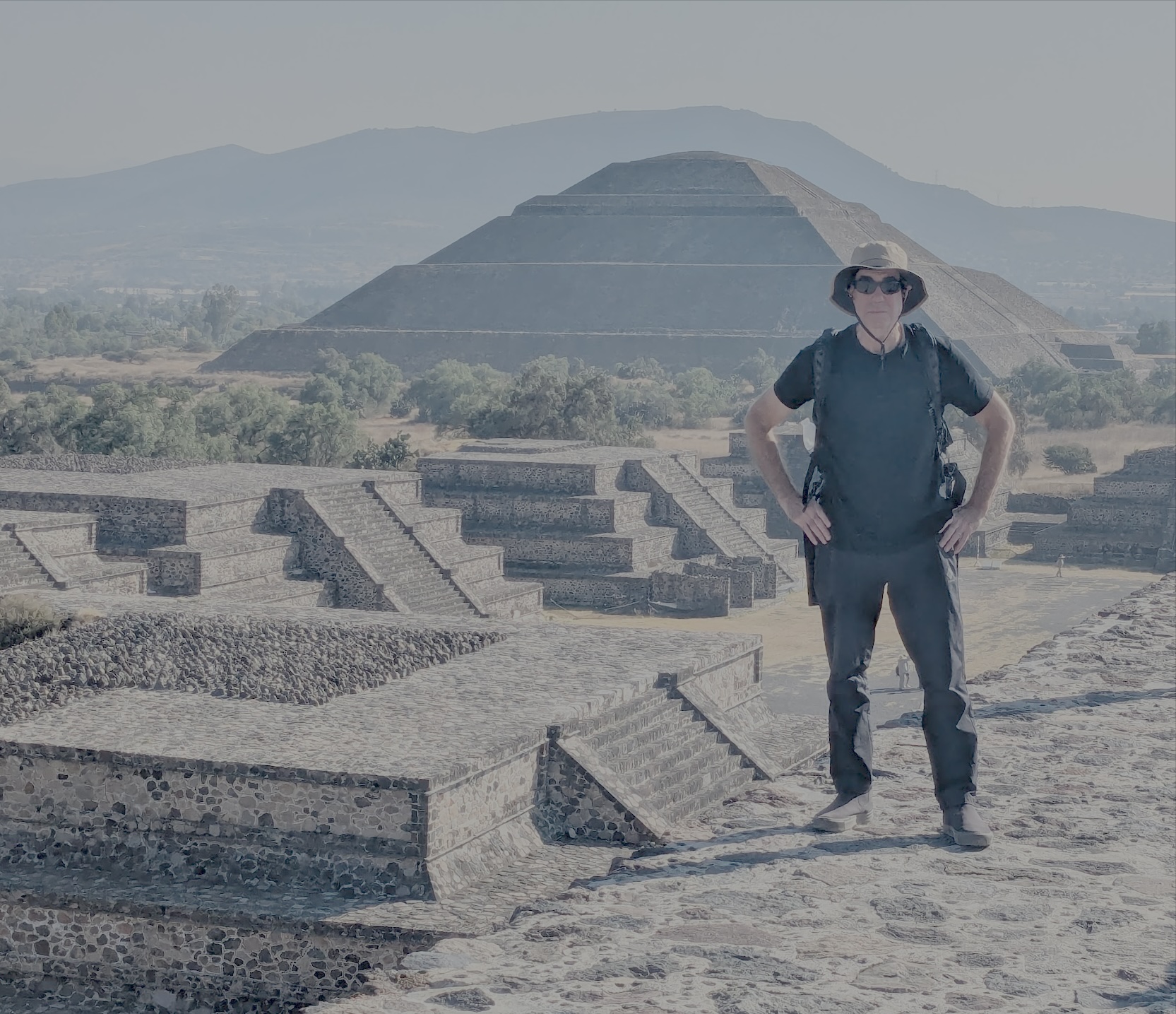
I am a computational linguist (which means that I have some things in common with grapefruit).
I am a Research Scientist at Sakana.ai in Tokyo. My work at Sakana focuses on natural language processing, image processing, and AI.
Prior to that I was a Research Scientist at Google, formerly in New York, then in Tokyo.
News
A follow-up to my 2022 Last Words piece, with Huayang Li as first author. We had hoped to publish this in the Last Words column at CL, but times have changed: the two reviews were generally positive and suggested resubmission with modifications, but the Action Editor chose to write a rather vindictive metareview that completely inverted the points made by the reviewers. You can see the full reviews here, along with Gemini’s analysis of the reviews and metareview here.
A new paper (Repo), on the ordered acquistion of quanta, "reusable computations acquired suddenly and binary-activated across examples to reduce loss."
A preprint that picks apart some recent claims about standardized symbols in Paleolithic inscriptions. The following post on the Language Log summarizes the main points.
Some Current Research Interests
At Sakana.ai, I work on various projects relating to Natural Language Processing and Artificial Intelligence. Some recent and/or ongoing projects:
- ProtoScribe: The accounting house game. Modeling the evolution of writing.
- Ordered acquisition of quanta (paper, code.)
- Generation of descriptions of Japanese Kamon (family crests) (code, data, paper, (in Japanese), paper on KamonBench benchmark).
- Modeling language change (paper, code).
- Constructed languages using LLMs (paper, code, blog post).
- RePo: Language Models with Context Re-Positioning (paper, code, blog and live demo).
- Reasoning-based evaluation of translation (paper, code).
- One ongoing project in this area is on the relevance of heraldry to writing systems (work done in association with the VIEWS Project at Cambridge University: slides; talk).
- I also presented at a conference on rongorongo, "Advancement in the Studies of the Easter Island Script" in Mexico City, November 2026: slides; talk.
At Google (2012-2024)
At Google I was mostly working on text normalization, where my former group had been developing various machine learning approaches to the problem of normalizing non-standard words in text and I have been particularly interested in the promise (and limitations) of approaches using recurrent neural nets. In September 2019, I moved to Google Tokyo, and worked on end-to-end speech understanding.
I continued to maintain some "side-bar interests" including computational models of the early evolution of writing, the statistical properties of non-linguistic symbol systems, and collaborating on a translation of Wolfgang von Kempelen's Mechanismus der menschlichen Sprache, which was published in 2017.
At the Oregon Health & Science University (2009-2012)
Prior to joining Google I was involved in a number of projects:
- An NSF-funded project on text-to-scene conversion: NSF: "RI: Medium: Collaborative Research: From Text to Pictures". In our piece of the project we are looking at using Amazon's Mechanical Turk to fill in semantic information into a frame-like ontology (e.g. parts of objects, how objects are typically used, frame information about verbs, etc.)
- An NIH (R01) funded project on "Computational characterization of language use in autism spectrum disorder".
- An NIH (K25) funded project on "NLP for Augmentative and Alternative Communication in Adults". The plan is to develop systems that can predict a set of plausible responses for an AAC-system user given the discourse context. In Spring of 2010, I taught (with Brian Roark) a Seminar on Speech and Language Processing for Augmentative and Alternative Communication.
- An NSF-funded project on Corpora of Non-Linguistic Symbol Systems.
- A CIA-funded project on text-normalization and genre adaptation for social media texts.
- OpenGRM: I ws involved in open-sourcing various tools for finite-state and other language processing, including some of the Google tools for grammar development.
At the University of Illinois, Urbana-Champaign (2003-2009)
- Multilingual spoken term detection: I was team leader of the 2008 Johns Hopkins Center for Language and Speech Processing workshop on this topic.
- Language modeling for colloquial Arabic speech recognition.
- Named entity detection and transliteration for multiple languages.
- Prediction of prosody from text for affective speech synthesis.
- Acoustic and pronunciation modeling for accented standard Chinese. (Follow-up on work done at the Hopkins 2004 workshop.)
- The relation to layout to phonological awareness in scripts of South Asia.
- Automated Methods for Second-Language Fluency Assessment.
- Interpretation of location descriptions for botanical/zoological specimen labels.
Once again, I have long been interested in writing systems; see, for example, some work I was doing on approximate string matching in the Easter Island rongorongo script. I also ran (with Jerry Packard) a reading group centered around Hannas' controversial thesis relating Asia's supposed technological creativity gap, with the Chinese writing system.
At AT&T Labs—Research and Bell Laboratories (1985-2003)
Before joining the faculty at UIUC I worked in the Information Systems and Analysis Research Department headed by Ken Church at AT&T Labs—Research, where I worked on Speech and Text Data Mining: extracting potentially useful information from large speech or text databases using a combination of speech/NLP technology and data mining techniques.
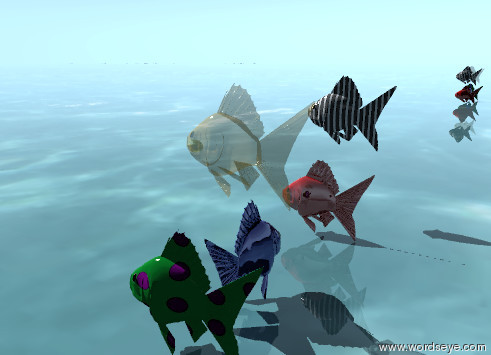
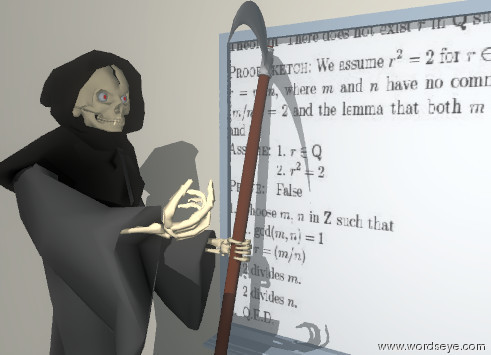
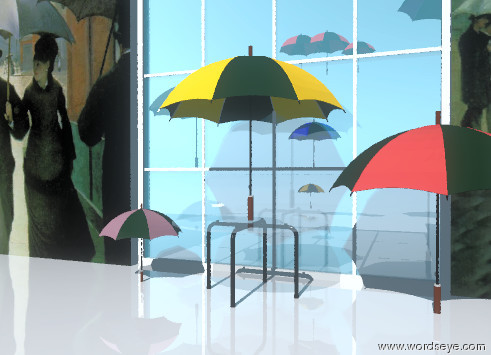
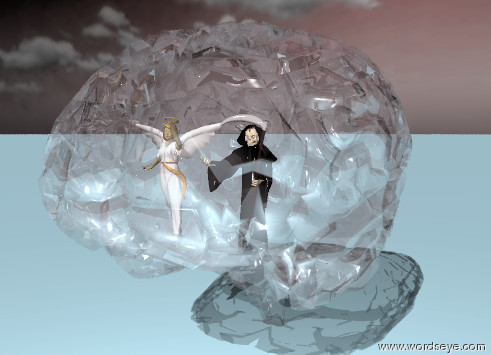
Before joining Ken's department I worked in the Human/Computer Interaction Research Department headed by Candy Kamm. My most recent project in that department was WordsEye, an automatic text-to-scene conversion system. The WordsEye technology is now being developed at WordsEye.com. WordsEye was particularly good for creating surrealistic images that I can easily conceive of but are well beyond my artistic ability to execute. And we were doing this 20 years before the "AI revolution"! All of the following images were generated from text descriptions of the scene:
|
|
|
|
Prior to joining AT&T Labs in 1999 I worked on Text-to-Speech Synthesis at Bell Labs, Lucent Technologies. Among other things, I was responsible for the multilingual text processing module of the Bell Labs Multilingual TTS System.